

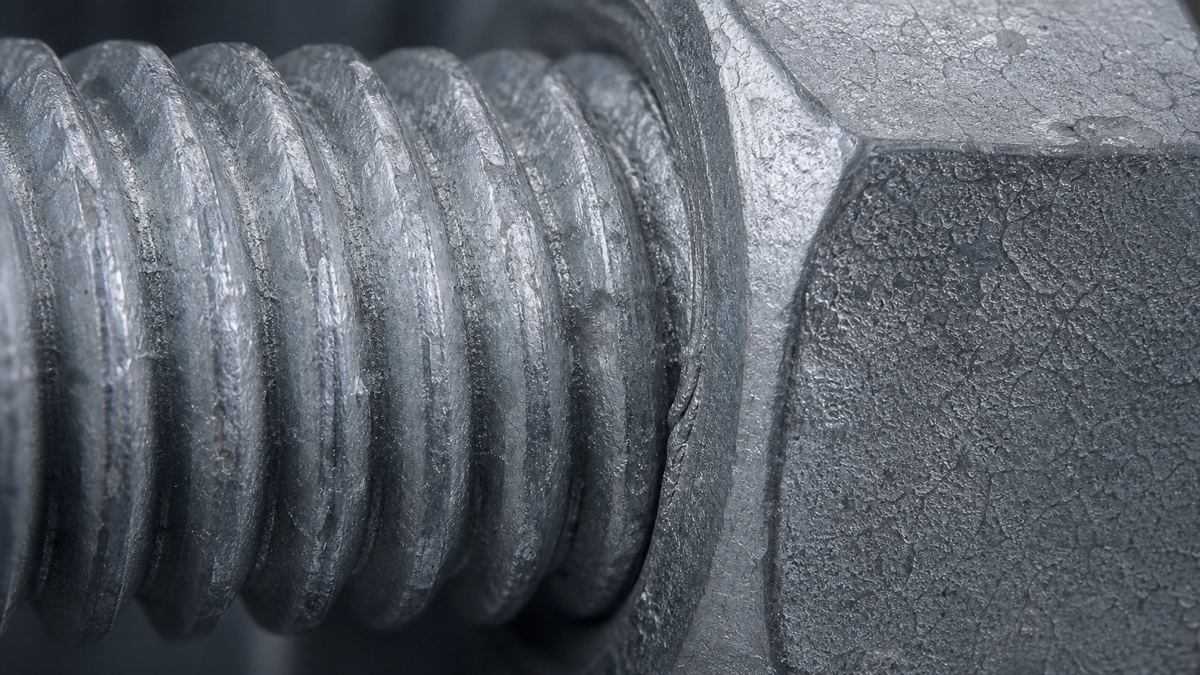
The bolts arrive galvanized. The nuts arrive in the same bundle, also galvanized. The first nut goes on two turns and stops.
Nothing is wrong with either part. Hot dip galvanizing is a metallurgical coating, not a paint film: the steel is dipped in molten zinc at roughly 860 degrees Fahrenheit, and zinc reacts with iron to form a zinc iron alloy layer before the outer free zinc layer forms. That reaction adds material to the thread, so a galvanized bolt is measurably larger than the same bolt in plain finish.
A thread is a tolerance fit. Unified coarse threads are made to a Class 2A allowance on the bolt and a Class 2B allowance on the nut, and the clearance between them is measured in thousandths of an inch. Add zinc and the fit is gone, unevenly, because coating thickness is inspected as an average over a reference area and zinc builds differently at thread roots than at crests.
The answer is an overtapped nut. ASTM A563 permits nuts intended for galvanized bolts to be tapped oversize by a defined amount, and the standard sets that allowance by diameter, so the assembly still has proper thread engagement after coating. Which means the nut matters as much as the bolt. Buy both from one manufacturer and the problem moves from the job site to the plant, where it is solved by gauge rather than by guess.
Which standard applies. F1554 anchor bolts are hot dip galvanized to ASTM F2329, which is written for zinc coating on steel fasteners and hardware. ASTM A153 Class C covers the same territory and is also accepted for this hardware. Both are legitimate. A line item that says galvanized and leaves the standard to the supplier is not. The F1554 anchor bolt range lists which finish applies to which grade.
- ASTM B633 is zinc electroplating, measured in microns rather than thousandths of an inch. It is an indoor coating, not corrosion protection for a bolt in a splash zone.
- ASTM B695 Class 50 mechanical zinc is roughly the same thickness as hot dip, about 2 mils, but the coating is less dense and thin at edges, so it carries less zinc. It is used where the heat of hot dip would distort a part.
- PTFE, Xylan, ceramic and epoxy are barrier coatings for specific chemical environments, useful and not interchangeable with zinc.
When a nut will not go on. Check the pairing first, because a plain finish nut from the site trailer will bind on a galvanized bolt every time. Then look for coating defects such as drips and zinc buildup at the thread entrance. Do not chase threads with a tap or die as routine practice, because it removes zinc from the load bearing flank. If it is done at all, it is a repair, and the repair is per ASTM A780, two coats of zinc rich paint on a properly prepared surface. A spray of cold galvanizing on a wet thread is not a repair.
We manufacture and galvanize F1554 anchor bolts in Grade 36, Grade 55 and Grade 105 and ship them with matching domestic A563 heavy hex nuts and F436 washers as one assembly. To avoid the thread fit conversation entirely, order galvanized anchor bolts as a matched assembly.
The finish callout is one of five in how to specify F1554 anchor bolts.
Contact us today to get a quote: 800-633-6794 or sales@atlrod.com